Wednesday, October 17, 2012

Student Success – The Importance of Taking Responsibility

Tips for Student Success - Photo by Tulane Public Relations on Wikimedia Commons
The majority of students want to be successful in the classroom, but success is often defined in a variety of ways. One student may wish to gain skills while another may be shooting for a particular grade. Some students may be motivated to meet minimum criteria to maintain a scholarship while others may be stepping out to provide a great example for family members.

Whatever the motivation, a key ingredient in becoming a successful student is the ability to accept responsibility for one's decisions. Most students have a full schedule while trying to juggle home life, academic life, and often a job. A plethora of opportunities often vie for one's time.

Be Realistic When Choosing a Schedule

Many students overestimate their ability to commit to a full load of classes while caring for family members and/or holding down a job. Traditional face-to-face classes will have time each week to meet, but many hours of study and work may be involved outside of class time. Online classes tend to require a great deal of self-discipline as many students in a virtual classroom must develop their own schedule for studying and completing assignments within the class guidelines.

One rule of thumb is to plan to spend three hours of studying/working for each class hour each week. Many students find it helpful to take a few less classes if they have a particularly busy life outside of the classroom. Developing a set time to study in an environment that has less distractions is also helpful for many students.

Be Responsible for Requirements of the Class

Professors want students to be successful and often provide many resources that spell out expectations for the class. Unfortunately, some students fail to look at that information until the end of the semester is approaching.

Look at the course syllabus and answer the following questions:
  • What is the grading scale? (Many students mistakenly assume the grading scale is the same for all classes.)
  • Is there a calendar of assignments?
  • Are some assignments worth more than others (weighting of grades)?
  • Can any assignment be dropped?
  • Is any extra credit available?
If you find that you are struggling on particular assignments, look for extra study opportunities and make sure you understand how each assignment is graded and ensure that you understand all information because many class assignments may build on knowledge acquired from previous assignments. Those with special needs may find it helpful to seek assistance through an accommodation plan.

Free tutoring may be available, and volunteers may provide feedback on written assignments. Students may find study groups helpful. Some online study resources are excellent. Ask the professor what he/she would recommend to improve scores in the future.

Be Ready for the Unexpected

Sometimes life has a way of pitching a curve ball when you least expect it. Things happen. If you have planned carefully throughout the semester, you may have a cushion that may help to keep your grade closer to target. Some professors may extend a deadline if you notify them of an emergency, particularly if you mention a special need before the due date. Some instructors may offer make-up assignments.

If you miss an assignment that cannot be made up, determine how this will affect your overall score and adjust your plan accordingly. Many students miss multiple assignments and begin asking about extra credit opportunities and/or make-up assignments during the week of final exams. This usually does not result favorably for a student who is struggling academically. Students who explore options and additional learning opportunities immediately after a missed assignment tend to create better damage control plans.

Not All Success is Measured by a Grade

I find that many students who do not get a perfect score may be learning more than those who test highly on each assignment. A student who begins with very low scores and begins to improve throughout the class are quite successful in my eyes. Students who honestly earn their grades will be more likely to retain that knowledge than those who are only concerned with getting a score at any cost.

Some of my most successful students completely changed gears after taking a class. Perhaps she discovered that a chosen career path was not at all what she had expected and decided to change majors. Finding one's passion and moving toward that goal can be one of the greatest learning experiences one can enjoy!

Readers may also wish to read How to Calculate Your Grade in a Class and How to Communicate With an Online Professor. Find more of Katrena's articles, flash cards, and practice tests at Student Survive 2 Thrive.

Tuesday, September 25, 2012

Free Medical Terminology Practice Test: Nervous System Cells

Learning basic anatomical and physiological terms related to the nervous system can be tough! This practice test focuses on nervous system cells. Many of these terms are not commonly known terms and some are difficult to spell, but after some studying, the nervous system will seem a little less intimidating.

How to use this free medical terminology practice test:
  1. Click on the first image below.
  2. Click on the next thumbnail at the bottom to advance to the next slide.
I hope you find this practice test to be helpful. Find more free resources, including tips, flash cards, and practice tests at the Student Survive 2 Thrive site map.

Study Guide for Cells of Nervous System

Free Medical Terminology Practice Test

What protects axons in nervous system?

Myelin sheath definition

Motor nerves that take impulses away from CNS

Efferent nerve definition

Neuron anatomy and basic parts


Oligodendrocyte definition

Space between two nerves

Synapse definition


Connective tissue that protects nervous system through phagocytosis


Neuroglia definition


Cell shaped like star in Central Nervous System


Astrocyte definition


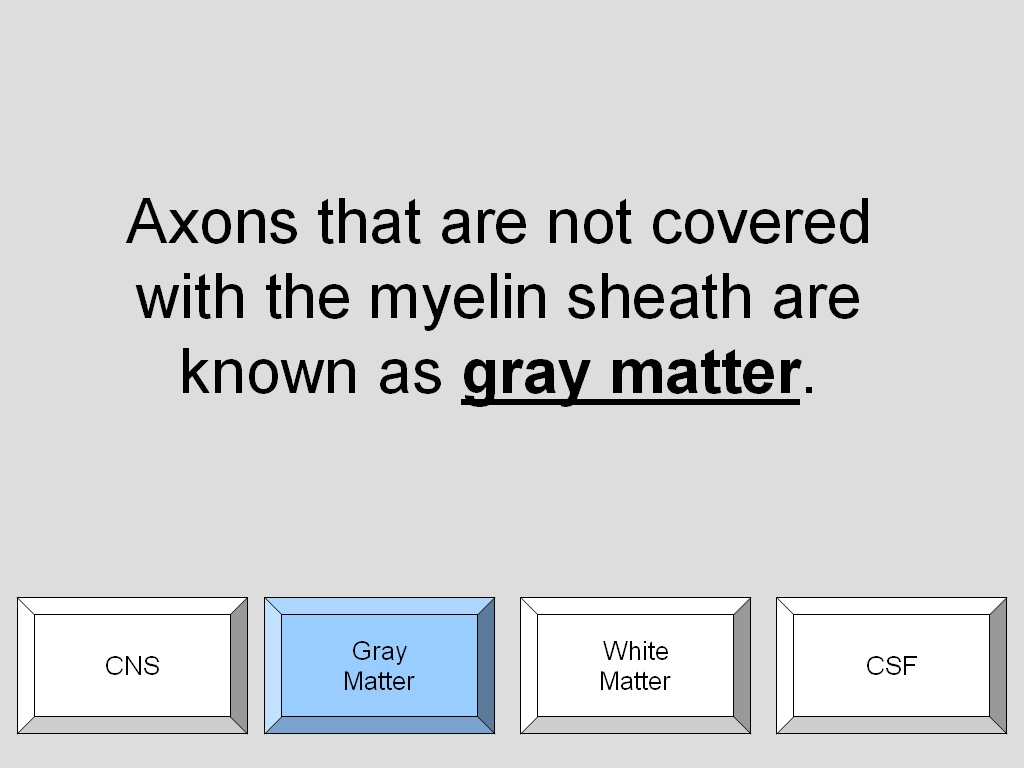
Axon not covered with myelin sheath


Gray matter definition


Nervous system cell that increases if tissue is damaged or infection is present


Microglial cells definition


Sensory nerves transmit impulses to CNS


Afferent nerves definition


Nervous system cell that looks like a tree


Dendrite definition


Functional unit of the nervous system


Neuron definition


Axons covered with myelin sheath


White matter definition


What does a synapse connect?


What is space between axon and dendrite?


Cells that form myelin sheath on nerves in body


Oligodendrocyte definition

What prevents harmful substances from entering brain?


Blood-brain barrier definition


Free Practice Test on Nervous System


Thursday, September 13, 2012

How to Communicate With an Online Instructor – Tips from a Professor

One of the first hurdles of taking an online class may be discovering how to get in touch with the professor or instructor. In a traditional classroom, it can be quite simple to ask a professor a question and get an on-the-spot answer; however, establishing two-way communication in an online setting usually takes a different approach. Developing a plan for communication upon entering an online class is often a great step in the right direction.

How to Talk with a Professor in an Online Class - Photo by KarlHeinrich at Wikimedia Commons
Why is communication important in an online class?
Although many students may take an online class and never have any issues, it can be quite stressful to a student who is trying to touch base with a professor to discover that messages are not being received by the instructor. On the flip side, if a professor is trying to send a message to a student, prompt receipt of that message may make the difference in whether or not the student successfully completes the class.

Below are tips for successfully commmunicating with an online instructor.

Look to see how the instructor prefers to be contacted.

An instructor will typically list contact information somewhere in the class. Several places that you might check for contact information include:
  • Instructor profile
  • Course syllabus
  • Announcement
  • Assignment (some instructors make early communication part of the first assignment)
Make note of this contact information and keep a hard copy for future reference throughout the semester. The professor will typically include an email address, question and answer forum, or may include other means of communication such as a phone number or office hours. If the instructor lists a home phone number, pay particular attention to preferred hours of contact if listed.

Tips for Being a Successful Student in an Online Class - Photo by BuzzFarmers from Wikimedia Commons
Avoid making assumptions.

Online professors vary greatly in their approach to communicating with students, so even if you have taken a class previously and found one way that worked well with another class or instructor, do not assume that is the preferred method for another instructor.

Be careful not to make assumptions with various types of communication. For example, do not assume that the professor has caller ID and will automatically know that you called. Instead, leave a message with your name, contact information, and a specific question if leaving a phone message. Do not assume that the professor can receive text messages on his or her phone. If you send a text to a phone that does not receive texts, this could quickly lead to miscommunication because the person texting may not receive any sort of message indicating that the text was not received.

Keep in mind that professors will probably not work 24/7 within a virtual classroom, so allow plenty of time before due dates if you have questions or issues related to a particular assignment. You may not get an instant response if you attempt to contact the professor at 11:45 p.m. when the assignment is due at midnight! Some instructors may specify a period of time in which you can expect a response from him or her.
How to Email a Professor - Photo by Loggie-log at Wikimedia Commons

Identify yourself and your class.

Some instructors may teach multiple classes with similar class names and student names. You may find that an instructor may respond to you more quickly and completely if you identify yourself. For example, you might email a professor with the following information:
  • Your first and last name as it appears in the class
  • The name of the class as listed by the learning institution
  • Group assignment if applicable
  • The specific nature of your question, comment, etc.
Professors may request that you include other identifying information in all correspondence, so make sure to check for his or her requirements. It helps to be as specific and clear as possible when asking questions. For example, if you are disputing a test question, provide the nature of the test question, the answer you think is correct, and supporting data from the class.

Carefully read your correspondence before posting/sending.

Some professors will post a Frequently Asked Questions (FAQ) section in class. Your question may already be answered in that area. Question and Answer forums or discussions are another great resource for students who may have questions. Sometimes other students may respond quickly with accurate information or may direct peers to the place to find answers to questions that are posted in forums or discussion boards.

Miscommunication can easily occur if a message is unclear. Take a few moments to read a message before sending or posting. Look for typos, omitted words, and other mistakes that could change a message entirely from the intended message. If you read your message and it does not make sense or seems unclear to you, imagine how difficult it might be for an instructor to decipher.

It is also helpful to maintain a professional attitude when communicating with an instructor. Avoid sending inflammatory or rude messages. Do not send unsolicited forwarded messages. Using ALL CAPS in online communication gives the impression that the sender is YELLING. Colors can be fun, but some combinations are very difficult to see, such as combining red and blue, all light colors, or all dark and/or bright colors. If you need to squint to read the message, it is pretty likely that the professor will also have a difficult time reading it also.

If you are unsure of a message or think you have received an erroneous message from the instructor after reading it several times, feel free to contact the professor for clarification.

Trouble-shooting Tips for Online Classes - Photo by Overton 2012 at Wikimedia Commons

Ensure that you can receive messages from the instructor.

The virtual classroom instructor will probably give give expectations for how often a student should check into the class and look for correspondence. If you have sent a professor an inquiry, it is very important that you check for his or her response in a timely manner.

If students are required to use a college-related email system, it would be wise to check that email on a scheduled, regular basis. If you have the option to choose an email address, many students find it convenient to pick one that they already check regularly. Many online instructors may email students through the virtual classroom, so it is important to adjust privacy settings within the class to enable the professor to email you via this system if applicable. Update your contact information as soon as possible if it changes during the semester.

Sometimes simply checking for messages may not be enough. Ensure that your inbox is not full or nearly full. Some filters may send a professor's messages to a spam email folder, so if you think the instructor has sent a message that you do not see, look for other folders to which it may have been re-routed.

Make sure that your email is secure and do not share your password with others. It is also helpful to select a strong password that you can remember. Seek technical assistance as soon as possible if you cannot get into the virtual classroom, email, or if something with your internet provider seems amiss. A backup plan for communication in case original plans prove lacking can be a very valuable resource as well.
How to Keep in Touch With College Professor - Photo by Aaron Pruzaniec at Wikimiedia Commons

Keeping Communication Lines Open

Although many students take online classes and may never need to directly communicate with the instructor about an issue, having a clear plan for doing so can be a valuable resource that shows your commitment to excellence and effective problem-solving techniques, which are very marketable skills. Maintaining clear two-way communication may also help you to successfully complete that online class!

Find more tips, study guides, flash cards, and practice tests by Katrena at the Student Survive 2 Thrive site map.

Sunday, August 12, 2012

Free Medical Terminology Practice Test: Skin Vocabulary

Find a wide variety of medical terminology involving the integumentary system with this medical terminology practice test. Some terms may seem a bit common; however, quite a few of the various terms may sound alike and may have corresponding medical terms that may not be as familiar.

How to use this skin vocabulary practice test:
  1. Click on the first image below to enlarge.
  2. Click on the next thumbnail at the bottom of the screen to advance to the next slide.

Other resources for studying the integumentary system include practice tests on skin lesions and pathological skin conditions. Check out my Student Survive 2 Thrive site map for additional flash cards, practice tests, and tips for students.

I hope you enjoy this practice test and find it useful for study purposes.

Medical Terminology Practice Test on Skin
Free Med Term Practice Test on Integumentary System
Tissue that covers internal and external body surfaces
Epidermis definition
Hair covering baby before birth
Lanugo definition
Medical term for sweat gland
Sudoriferous gland definition
Med term for study of the skin
Dermatology definition
Openings in skin where substances are excreted
Skin pores definition
Med term for thick, uniform layer of cells
Stratum definition
Natural blood thinner in the body
Heparin definition
Med term for pale area on fingernail or toenail
Lunula defintion
Medical term for skin
Integument definition
Name of protein in ligaments, tendons, and fascia
Collagen definition
Medical term for visible part of the hair
Hair shaft definition
Medical term for sweat
Perspiration definition
Medical term for oil gland
Sebaceous gland definition
Name for a skin doctor
Dermatologist definition
Medical term for deepest skin layer
Basal layer definition
Medical term for scar
Cicatrix definition
Histiocyte definition
Macrophage definition
Name for outer skin layer
Stratum corneum definition
Cell that contains heparin and histamine
Mast cell definition
Cutaneous membrane definition
Medical term for skin
Diaphoresis definition
Medical term for sweat
Parts of the integumentary system
Parts of the body included as skin
What makes a person's skin darker?
Melanin definition
What makes teeth and nails hard?
Keratin definition
Medical term for ear wax
Cerumen definition
Lipocyte definition
Medical term for fat cell
Name of substance body releases in allergic reaction
Histamine definition
What makes ear wax?
Ceruminous gland definition
Tissue covering internal and external body surfaces
Epithelium definition
Medical term for blue skin
Cyanosis definition
Medical term for fat under skin
Subcutaneous tissue definition
Cutaneous papilloma definition
Medical term for skin tag
Medical term for dermis
Corium definition
Medical term for red skin
Erythema definition
Medical term for skin covering root of fingernail or toenail
Cuticle definition
Lines on skin from stretching and growing quickly
Stretch mark definition
Medical term for oily secretions
Sebum definition
Cell that eats microorganisms, foreign particles, and other cells
Histiocyte definition
Inflammation of skin around fingernail
Paronychia definition
Part of fingernail you can see
Nail body definition
Free practice test on skin