Showing posts with label World War I. Show all posts

Thursday, July 20, 2023

Week 23 U.S. History: Americans and the Great War, 1914-1919


Photo of teleprinter by Ray_Shrewsberry at https://pixabay.com/photos/telegraph-key-communication-retro-4891039/
Photo of teleprinter by Ray_Shrewsberry at
https://pixabay.com/photos/telegraph-key-communication-retro-4891039/ 

U.S. History Week 23

Americans and the Great War, 1914-1919

I designed a quiz related to chapter 23 at the bottom of this article.

Directions for the quiz:

  1. Scroll down & click on the first thumbnail to enlarge to full screen.
  2. Choose an answer for each question.
  3. Click on the graphic to advance to the next screen.
  4. The correct answer is on the screen following the question.
  5. Compare your answers with those provided.
  6. If you cannot easily see the correct answer, check the captions.

An interactive version is available on Kahoot!
Search for this week’s topic by Katrena to find it.

Review the following Chapter 23 pages:

Practice learning Chapter 23 Key Terms on Quizlet.


Week 23 Videos:

Review the following information featuring the U.S.:

Additional Resources:

Thanks for visiting my Student Survive 2 Thrive blog!

Find additional resources through my site map, topics tabs, or search bar.

Here are some of my articles you may find helpful this week:

U.S. History Week 23 Americans and the Great War 1914-1919
U.S. History Week 23 Americans and the Great War 1914-1919 

Created by Katrena All rights reserved.
Created by Katrena All rights reserved. 

Despite President Warren Wilson’s promise not to rely on the Roosevelt Corollary, troops were sent to the all except: Answer choices include: Haiti, Hispaniola, Canada, Cuba
Despite President Warren Wilson’s promise not to rely on
the Roosevelt Corollary, troops were sent to the all except:
Answer choices include: Haiti, Hispaniola, Canada, Cuba

The correct answer is Canada.

The U.S. originally backed ___ in Mexico but later recognized Carranza’s government, sparking his revenge. Answer choices include: Erik Morales, Pancho Villa, Julio César Chávez, Salvador Sánchez
The U.S. originally backed ___ in Mexico but later
recognized Carranza’s government, sparking his revenge.
Answer choices include: Erik Morales,
Pancho Villa, Julio César Chávez, Salvador Sánchez

The correct answer is Pancho Villa.

Which of the following was not part of the Triple Entente? Answer choices include: Germany, France, Russia, Great Britain
Which of the following was not part of the Triple Entente?
Answer choices include: Germany, France, Russia, Great Britain

The correct answer is Germany.

On May 7, 1915, a German U-Boat attacked a British passenger ship named ___ traveling from New York. Answer choices include: Oceanic, Olympic, Titanic, Lusitania
On May 7, 1915, a German U-Boat attacked a British
passenger ship named ___ traveling from New York.
Answer choices include: Oceanic, Olympic, Titanic, Lusitania

The correct answer is Lusitania.

The Zimmerman telegraph revealed Germany’s plan to entice ___ into the war. Answer choices include: Mexico, Italy, the United States, China
The Zimmerman telegraph revealed
Germany’s plan to entice ___ into the war.
Answer choices include:
Mexico, Italy, the United States, China

The correct answer is Mexico.

Who was the first woman elected to the U.S. Congress? Answer choices include: Grace Banker, Jeanette Rankin, Mata Hari, Iona Zollner
Who was the first woman elected to the U.S. Congress?
Answer choices include: Grace Banker,
Jeanette Rankin, Mata Hari, Iona Zollner

The correct answer is Jeanette Rankin.

When did Congress pass the Selective Service Act requiring all men aged 21-30 to register for the draft? Answer choices include: 1847, 1897, 1917, 1937
When did Congress pass the Selective Service Act
requiring all men aged 21-30 to register for the draft?
Answer choices include: 1847, 1897, 1917, 1937

The correct answer is 1917.

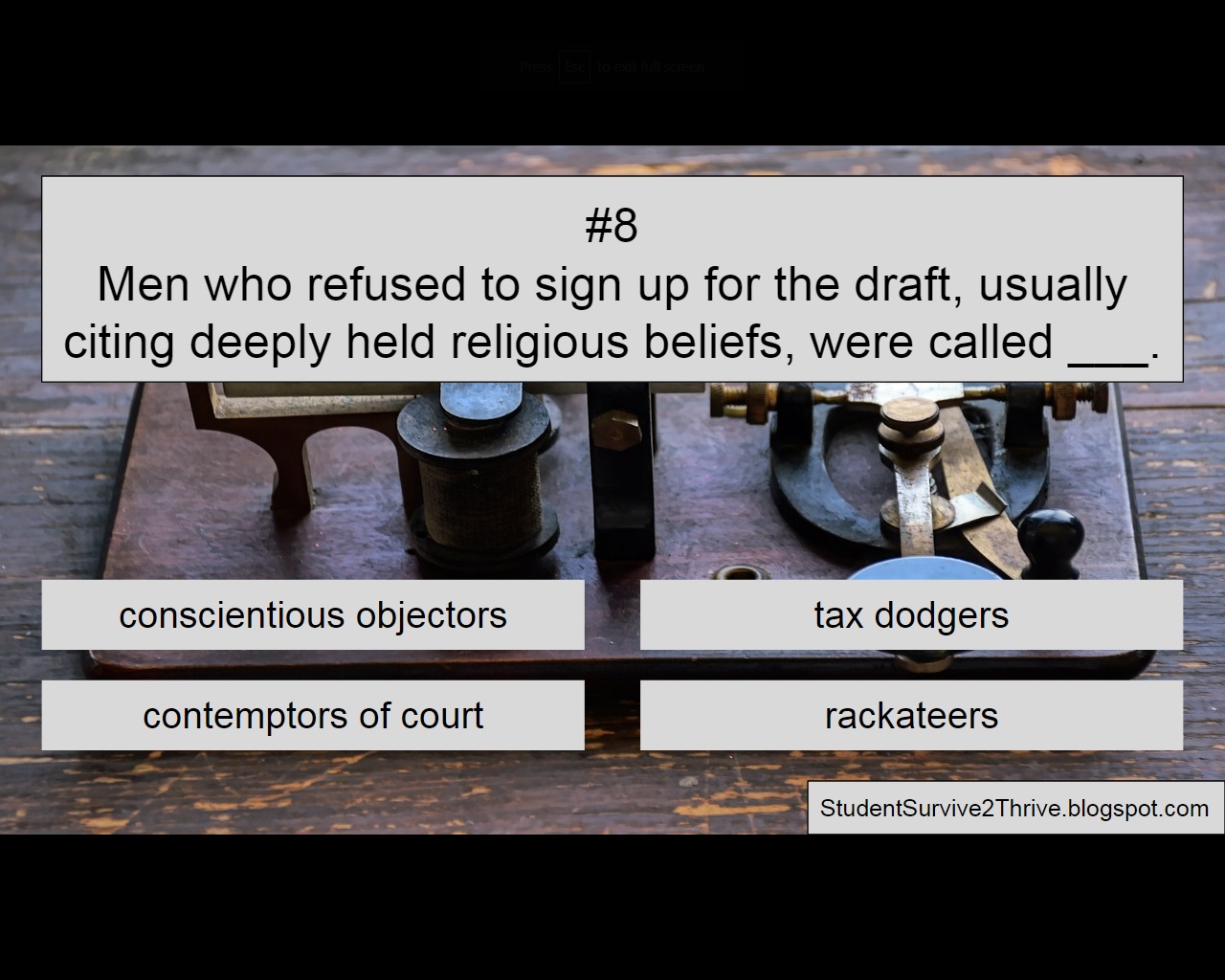
Men who refused to sign up for the draft, usually citing deeply held religious beliefs, were called ___. Answer choices include: conscientious objectors, tax dodgers, contempters of court, rackateers
Men who refused to sign up for the draft, usually
citing deeply held religious beliefs, were called ___.
Answer choices include: conscientious objectors,
tax dodgers, contemptors of court, rackateers

The correct answer is conscientious objectors.

Harry Garfield implemented ___ to allow more production. Answer choices include: standard time, psychological time, daylight savings time, metric time
Harry Garfield implemented ___ to allow more production.
Answer choices include: standard time,
psychological time, daylight savings time, metric time

The correct answer is daylight savings time.

The U.S. government eventually raised $32 billion for World War I expenses through ___. Answer choices include: national yard sales, liberty bonds, rationing, gold & diamonds
The U.S. government eventually raised $32 billion
for World War I expenses through ___.
Answer choices include: national yard sales,
liberty bonds, rationing, gold & diamonds

The correct answer is liberty bonds.

America’s WWI propaganda campaign encouraged an anti-___ attitude. Answer choices include: French, American, British, German
America’s WWI propaganda campaign
encouraged an anti-___ attitude.
Answer choices include:
French, American, British, German

The correct answer is German.

During WWI, wage increases were offset by an increased cost of living. Answer choices include: true, false
During WWI, wage increases were offset
by an increased cost of living.
Answer choices include: true, false

The correct answer is true.

WWI brought many career opportunities for women, who were paid equal wages, highly respected, & offered permanent jobs. Answer choices include: true, false
WWI brought many career opportunities for women,
who were paid equal wages, highly
respected, & offered permanent jobs.
Answer choices include: true, false

The correct answer is false.

The 369th Infantry, made up of African Americans called the ___, valiantly served 6 months on the frontline in France. Answer choices include: Graybacks, Buffalo Soldiers, Harlem Hellfighters, Rough Riders
The 369th Infantry, made up of African Americans called the ___,
valiantly served 6 months on the frontline in France.
Answer choices include: Graybacks,
Buffalo Soldiers, Harlem Hellfighters, Rough Riders

The correct answer is Harlem Hellfighters.

What influenced President Wilson’s passage of the 19th Amendment? Answer choices include: his daughters, women's roles during WWI, suffragist hunger strikes, all of these
What influenced President Wilson’s passage of the 19th Amendment?
Answer choices include: his daughters, women's roles during WWI,
suffragist hunger strikes, all of these

The correct answer is all of these.

Wilson’s peace plan for a new world order was called ___. Answer choices include: Camp David Accords, Fourteen Points, World Armistice, Entente Cordiate
Wilson’s peace plan for a new world order was called ___.
Answer choices include: Camp David Accords,
Fourteen Points, World Armistice, Entente Cordiate

The correct answer is Fourteen Points.

Which country signed a “war guilt clause,” taking public responsibility for starting the war? Answer choices include: Germany, Switzerland, Serbia, Bulgaria
Which country signed a “war guilt clause,”
taking public responsibility for starting the war?
Answer choices include:
Germany, Switzerland, Serbia, Bulgaria

The correct answer is Germany.

Who served as President Wilson’s de facto president for about 6 months after he suffered a stroke in 1919? Answer choices include: Thomas R. Marshall, Edith Wilson, Joseph Patrick Tumulty, James Beauchamp Clark
Who served as President Wilson’s de facto president
for about 6 months after he suffered a stroke in 1919?
Answer choices include: Thomas R. Marshall, Edith Wilson,
Joseph Patrick Tumulty, James Beauchamp Clark

The correct answer is Edith Wilson.

The U.S. never officially signed the Treaty of Versailles or joined the League of Nations after The Great War. Answer choices include: true, false
The U.S. never officially signed the Treaty of Versailles or
joined the League of Nations after The Great War.
Answer choices include: true, false

The correct answer is true.

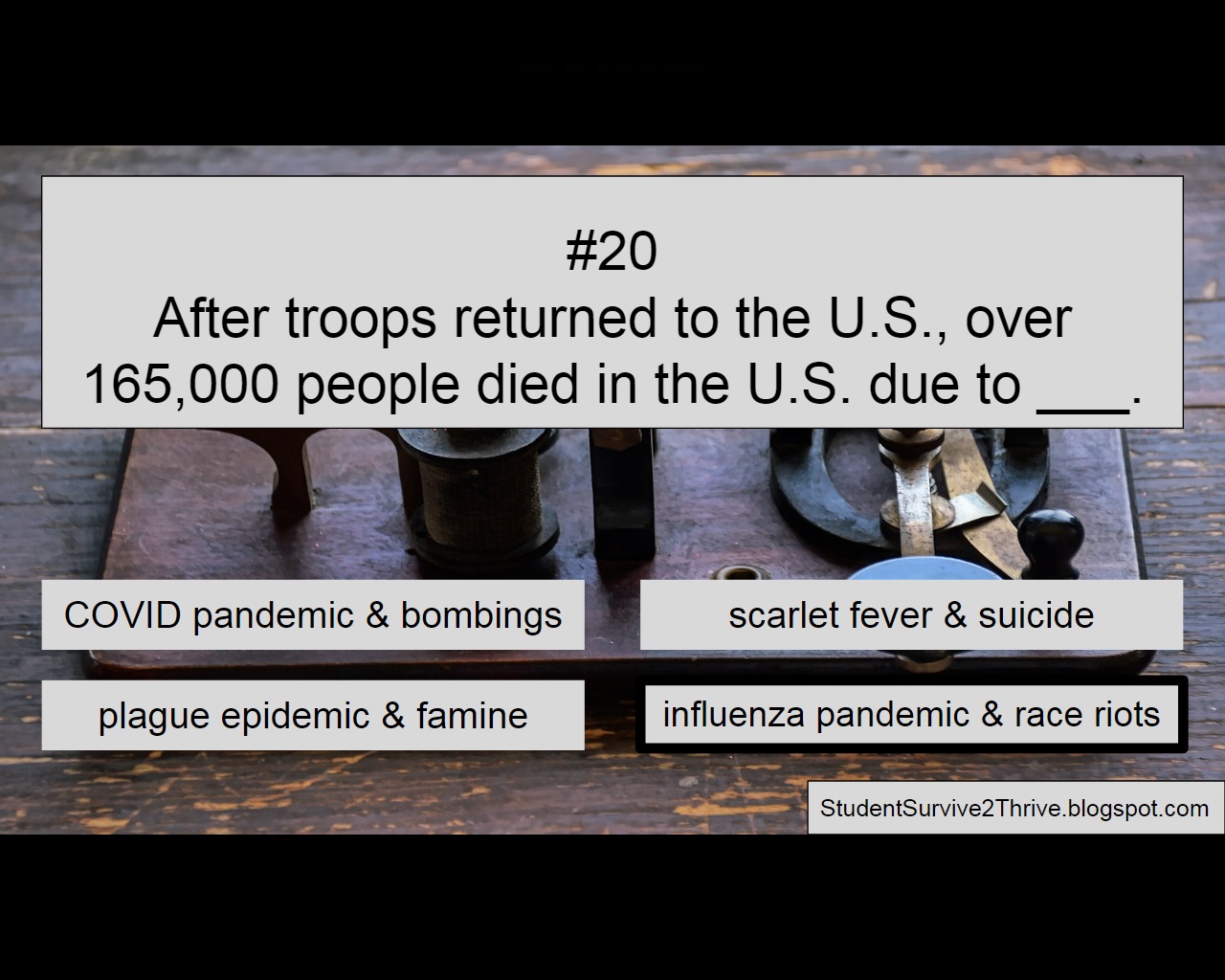
After troops returned to the U.S., over 165,000 people died in the U.S. due to ___. Answer choices include: COVID pandemic & bombings, scarlet fever & suicide, plague epidemic & famine, influenza pandemic & race riots
After troops returned to the U.S., over 165,000
people died in the U.S. due to ___.
Answer choices include:
COVID pandemic & bombings,
scarlet fever & suicide,
plague epidemic & famine,
influenza pandemic & race riots

The correct answer is influenza pandemic & race riots.

Find more resources at StudentSurvive2Thrive.blogspot.com
Find more resources at StudentSurvive2Thrive.blogspot.com 


Sunday, June 4, 2023

Week 29 World History: The Great War (World War I) 1914-1918

Stones in a German Military Cemetery photo by dendoktoor at https://pixabay.com/photos/cemetery-german-military-cemetery-7949666/
Stones in a German Military Cemetery photo by dendoktoor at
https://pixabay.com/photos/cemetery-german-military-cemetery-7949666/

 This world history resource focuses on World War I (The Great War)
from 1914 to 1918 and includes quiz questions and answers
and video links to related topics.

I utilized World History: Patterns of Interaction (Holt McDougal) for our world history textbook. It has multiple options for different learning styles and covers a wide array of information.

This quiz accompanies Chapter 29: pages 838-863.

Directions for the quiz:

  • Scroll down and click on the thumbnail to enlarge to full screen.
  • Click on the graphic to advance to the next screen.
  • Choose an answer for each question.
  • Compare your answers with those provided.

If you are interested in a group and/or interactive version of this quiz,
log in to Kahoot! and search for Week 29 World History by Katrena.

Below are free videos to accompany chapter 29:

Thanks for visiting my Student Survive 2 Thrive blog.

Navigate my blog easily through my site map, topics
tabs on the right, or via my search bar.


Here are a few of my articles you may also find helpful this week:


World History Week 29 The Great War (World War I) 1914-1918

Created by Katrena. All rights reserved.

Which of the following were considered Europe’s Great Powers at the turn of the 20th Century? Answer choices include: Bulgaria, Greece, Montenegro, Bulgaria, Serbia; China, Japan, the Philippines, Korea, Vietnam; Morocco, Libya, Egypt, Sudan, Tunisia; Austria-Hungary, Germany, Italy, Great Britain, France, Russia
Which of the following were considered Europe’s Great Powers
at the turn of the 20th Century? Answer choices include:
Bulgaria, Greece, Montenegro, Bulgaria, Serbia;
China, Japan, the Philippines, Korea, Vietnam;
Morocco, Libya, Egypt, Sudan, Tunisia;
Austria-Hungary, Germany, Italy, Great Britain, France, Russia

The correct answer is: Austria-Hungary, Germany, Italy, Great Britain, France, Russia

___ is the policy of glorifying military power and keeping an army prepared for war. Answer choices include: Freudism, Militarism, Industrialism, Pacifism
___ is the policy of glorifying military power
and keeping an army prepared for war.
Answer choices include:
Freudism, Militarism, Industrialism, Pacifism

The correct answer is militarism.

All of the following were cousins EXCEPT __. Answer choices include: Kaiser Wilhelm II of Germany, George V of Great Britain, Franz Joseph of Austria, Nicholas II of Russia
All of the following were cousins EXCEPT __.
Answer choices include: Kaiser Wilhelm II of Germany,
George V of Great Britain, Franz Joseph of Austria, Nicholas II of Russia

The correct answer is Franz Joseph of Austria.

The Balkans, a mountainous peninsula in the southeastern corner of Europe, was called the “___” of Europe. Answer choices include: powder keg, melting pot, peace seat, cultural center
The Balkans, a mountainous peninsula in the southeastern corner
of Europe, was called the “___” of Europe.
Answer choices include: powder keg, melting pot, peace seat, cultural center

The correct answer is powder keg.

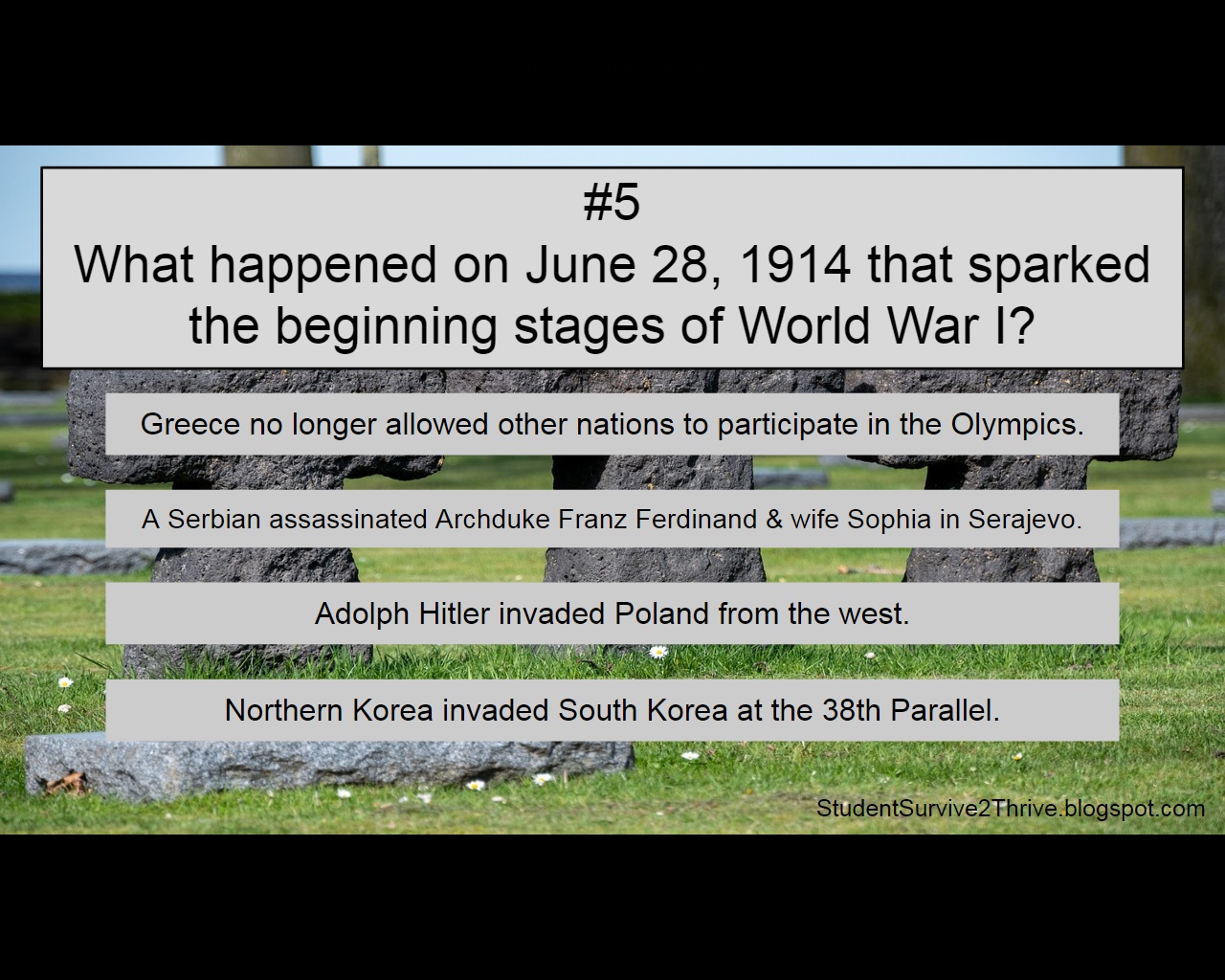
What happened on June 28, 1914 that sparked the beginning stages of World War I? Answer choices include: Greece no longer allowed other nations to participate in the Olympics. A Serbian assassinated Archduke Franz Ferdinand & wife Sophia in Serajevo. Adolph Hitler invaded Poland from the west. Northern Korea invaded South Korea at the 38th Parallel.
What happened on June 28, 1914 that sparked the
beginning stages of World War I?
Answer choices include:
Greece no longer allowed other nations to participate in the Olympics.
A Serbian assassinated Archduke Franz Ferdinand & wife Sophia in Serajevo.
Adolph Hitler invaded Poland from the west.
Northern Korea invaded South Korea at the 38th Parallel.

The correct answer is: A Serbian assassinated Archduke Franz Ferdinand & wife Sophia in Serajevo.
The correct answer is:
A Serbian assassinated Archduke Franz Ferdinand
& wife Sophia in Serajevo.

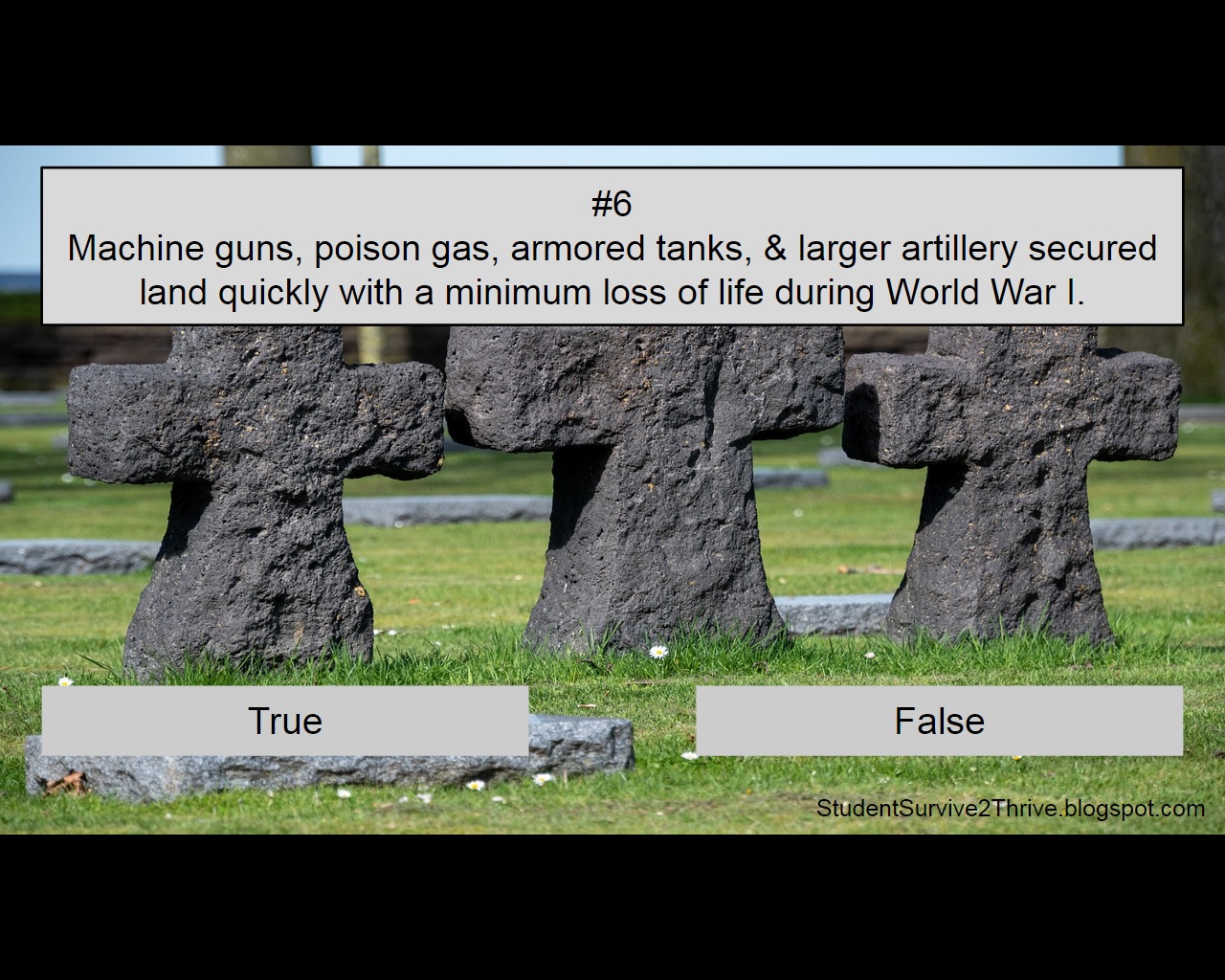
Machine guns, poison gas, armored tanks, & larger artillery secured land quickly with a minimum loss of life during World War I. Answer choices include: true, false
Machine guns, poison gas, armored tanks, & larger artillery secured
land quickly with a minimum loss of life during World War I.
Answer choices include: true, false

The correct answer is false.

What was Russia’s biggest asset during  World War I? Answer choices include: They controlled the Baltic Sea. They had large numbers of people to fight. They launched a relentless submarine campaign. They controlled straits leading from the Mediterranean to the Black Sea.
What was Russia’s biggest asset during  World War I?
Answer choices include:
They controlled the Baltic Sea.
They had large numbers of people to fight.
They launched a relentless submarine campaign.
They controlled straits leading from the Mediterranean to the Black Sea.

The correct answer is: They had large numbers of people to fight.

World War I introduced airplane warfare. Answer choices include: true, false
World War I introduced airplane warfare.
Answer choices include: true, false

The correct answer is true.

___ is the only South American country to offer support during World War I. Answer choices include: Panama, Argentina, Ecuador, Brazil
___ is the only South American country to offer support during World War I.
Answer choices include: Panama, Argentina, Ecuador, Brazil

The correct answer is Brazil.

Why did the United States enter World War I? Answer choices include: German U-boats sank three American ships. A telegram was intercepted that stated Germany would help Mexico “reconquer” land in the U.S. Germany agreed to stop attacking neutral passenger ships but reverted to unrestricted submarine warfare. All of these
Why did the United States enter World War I?
Answer choices include:
German U-boats sank three American ships.
 A telegram was intercepted that stated Germany would
help Mexico “reconquer” land in the U.S.
Germany agreed to stop attacking neutral passenger ships
but reverted to unrestricted submarine warfare.
All of these

The correct answer is all of these.

What caused the most deaths during World War I? Answer choices include: air warfare, influenza epidemic, trench warfare, amphibious warfare
What caused the most deaths during World War I?
Answer choices include: air warfare, influenza epidemic,
trench warfare, amphibious warfare

The correct answer is influenza epidemic.

People were only allowed to purchase small amounts of certain items as the war continued. This is called ___. Answer choices include: propaganda, rationing, censoring, ballistic communication
People were only allowed to purchase small amounts of certain items
as the war continued. This is called ___.
Answer choices include:
propaganda, rationing, censoring, ballistic communication

The correct answer is rationing.

___ was common as governments presented 1-sided information to increase morale & persuade support for war efforts. Answer choices include: Unbiased reporting, Propaganda, Blogging, Flash mobbing
___ was common as governments presented 1-sided information to
increase morale & persuade support for war efforts.
Answer choices include:
Unbiased reporting, Propaganda, Blogging, Flash mobbing

The correct answer is propaganda.

Women replaced men in factories, offices, & shops as well as providing food at home during World War I. Answer choices include: true, false
Women replaced men in factories, offices, & shops as well as
providing food at home during World War I.
Answer choices include: true, false

The correct answer is true.

After Russia withdrew from the war, upon which country did Germany increase their attacks? Answer choices include: France, Switzerland, the Netherlands, Serbia
After Russia withdrew from the war, upon which
country did Germany increase their attacks?
Answer choices include: France, Switzerland, the Netherlands, Serbia

The correct answer is France.

On November 11, 1918, World War I ended when leaders of Germany & France signed a/n ___, an agreement to stop fighting. Answer choices include: healthcare power of attorney, corpus delicti, quid pro quo, armistice
On November 11, 1918, World War I ended when leaders of
Germany & France signed a/n ___, an agreement to stop fighting.
Answer choices include: healthcare power of attorney,
corpus delicti, quid pro quo, armistice

The correct answer is armistice.

How many soldiers died as a result of World War I? Answer choices include: 8,500; 85,000; 850,000; over 8.5 million
How many soldiers died as a result of World War I?
Answer choices include: 8,500; 85,000; 850,000; over 8.5 million

The correct answer is over 8.5 million.

Countless civilians died during World War I.  What caused their deaths? Answer options include: slaughter, starvation, disease, all of these
Countless civilians died during World War I.  What caused their deaths?
Answer options include: slaughter, starvation, disease, all of these

The correct answer is all of these.

Which president entered the U.S. into World War I & created the 14 Points, outlining a plan for achieving just & lasting peace? Answer choices include: George Washington, Woodrow Wilson, Dwight Eisenhower, Gerald Ford
Which president entered the U.S. into World War I
& created the 14 Points,
outlining a plan for achieving just & lasting peace?
Answer choices include:
George Washington, Woodrow Wilson, Dwight Eisenhower, Gerald Ford

The correct answer is Woodrow Wilson.

According to the war-guilt clause in the Treaty of Versailles, which country was responsible for World War I? Answer choices include: Russia, France, Germany, Great Britain
According to the war-guilt clause in the Treaty of Versailles,
which country was responsible for World War I?
Answer choices include: Russia, France, Germany, Great Britain

The correct answer is Germany.

Find more resources at StudentSurvive2Thrive.blogspot.com