Showing posts with label World History OER. Show all posts

Monday, June 5, 2023

Week 30 World History: Revolution and Nationalism 1900-1939


Photo of Winter Palace in St. Petersburg Russia by islandworks at https://pixabay.com/photos/hermitage-st-petersburg-s-2612663/

This world history resource focuses on revolutions
and nationalism during the years between 1900 and 1939
and includes quiz questions and answers and video links to related topics.

I utilized World History: Patterns of Interaction (Holt McDougal) for our world history textbook. It has multiple options for different learning styles and covers a wide array of information.

This quiz accompanies Chapter 30: pages 864-893.

Directions for the quiz:

  • Scroll down and click on the thumbnail to enlarge to full screen.
  • Click on the graphic to advance to the next screen.
  • Choose an answer for each question.
  • Compare your answers with those provided.

If you are interested in a group and/or interactive version of this quiz,
log in to Kahoot! and search for Week 30 World History by Katrena.

Below are free videos to accompany chapter 30:

Thanks for visiting my Student Survive 2 Thrive blog.

Navigate my blog easily through my site map, topics
tabs on the right, or via my search bar.


Here are a few of my articles you may also find helpful this week:


World History Week 30: Revolution and Nationalism 1900-1939

Created by Katrena. All rights reserved.

When Alexander II ruled in Russia, who would most likely be labeled as dangerous? Answer choices include: Someone who worshipped in the Russian Orthodox Church, Someone who spoke a language other than Russian, Someone who believed in the czar’s absolute authority, Teachers who sent detailed reports on every student
When Alexander II ruled in Russia, who would most likely be labeled as dangerous?
Answer choices include:
Someone who worshipped in the Russian Orthodox Church,
Someone who spoke a language other than Russian,
Someone who believed in the czar’s absolute authority,
Teachers who sent detailed reports on every student

The correct answer is: Someone who spoke a language other than Russian
The correct answer is:
Someone who spoke a language other than Russian

Where were Russia’s political prisoners sent in the late 1800s? Answer choices include: Siberia, Australia, United States, Dead Sea
Where were Russia’s political prisoners sent in the late 1800s?
Answer choices include: Siberia, Australia, United States, Dead Sea

The correct answer is Siberia.

In 1917, Russians revered ___ as  the “Father of the Revolution.” Answer choices include: Bolsheviks, Gorbachev, Rasputin, Lenin
In 1917, Russians revered ___ as  the “Father of the Revolution.”
Answer choices include: Bolsheviks, Gorbachev, Rasputin, Lenin

The correct answer is Lenin.

What was FALSE regarding industrialization of Russia in the late 1800 & early 1900s? Answer choices include: There were poor working conditions & child labor. Wages were high and led to an improved economy. Some workers organized strikes. The Trans-Siberian Railway connected western Russia with the eastern coast.
What was FALSE regarding industrialization of Russia in the late 1800 & early 1900s?
Answer choices include:
There were poor working conditions & child labor.
Wages were high and led to an improved economy.
Some workers organized strikes.
The Trans-Siberian Railway connected western Russia with the eastern coast.

The correct answer is: Wages were high and led to an improved economy.

What happened after ~200,000 workers/families asked for better conditions, more freedom & an elected legislature at Winter Palace? Answer choices include: The czar agreed to their petition & signed it into law. The czar was not at the palace & they were told to go home. The czar said he would read the petition & ignored their requests. Soldiers fired on the crowd, wounding >1000 & killing hundreds.
What happened after ~200,000 workers/families asked for better conditions, more freedom & an elected legislature at Winter Palace?
Answer choices include:
The czar agreed to their petition & signed it into law.
The czar was not at the palace & they were told to go home.
The czar said he would read the petition & ignored their requests.
Soldiers fired on the crowd, wounding >1000 & killing hundreds.

The correct answer is: Soldiers fired on the crowd, wounding >1000 & killing hundreds.

When Czar Nicholas II moved his headquarters to the war front, his wife ran the government while being advised by Rasputin. Answer choices include: true, false
When Czar Nicholas II moved his headquarters to the war front,
his wife ran the government while being advised by Rasputin.
Answer choices include: true, false

The correct answer is true.

Vladimir Lenin’s Union of Soviet Socialist Republics (USSR) resulted in a “dictatorship of the proletariat” in which peasants owned all of the country’s wealth. Answer choices include: true, false
Vladimir Lenin’s Union of Soviet Socialist Republics (USSR) resulted in a
“dictatorship of the proletariat” in which peasants owned all of the country’s wealth.
Answer choices include: true, false

The correct answer is false.

Which of the following is/are traits of totalitarianism? Answer choices include: The government demands loyalty while denying basic liberties. Rules are enforced through terror, indoctrination, censorship & persecution. Governmental propaganda is spread via mass communication. All of these
Which of the following is/are traits of totalitarianism?
Answer choices include:
The government demands loyalty while denying basic liberties.
Rules are enforced through terror, indoctrination, censorship & persecution.
Governmental propaganda is spread via mass communication.
All of these

The correct answer is all of these.

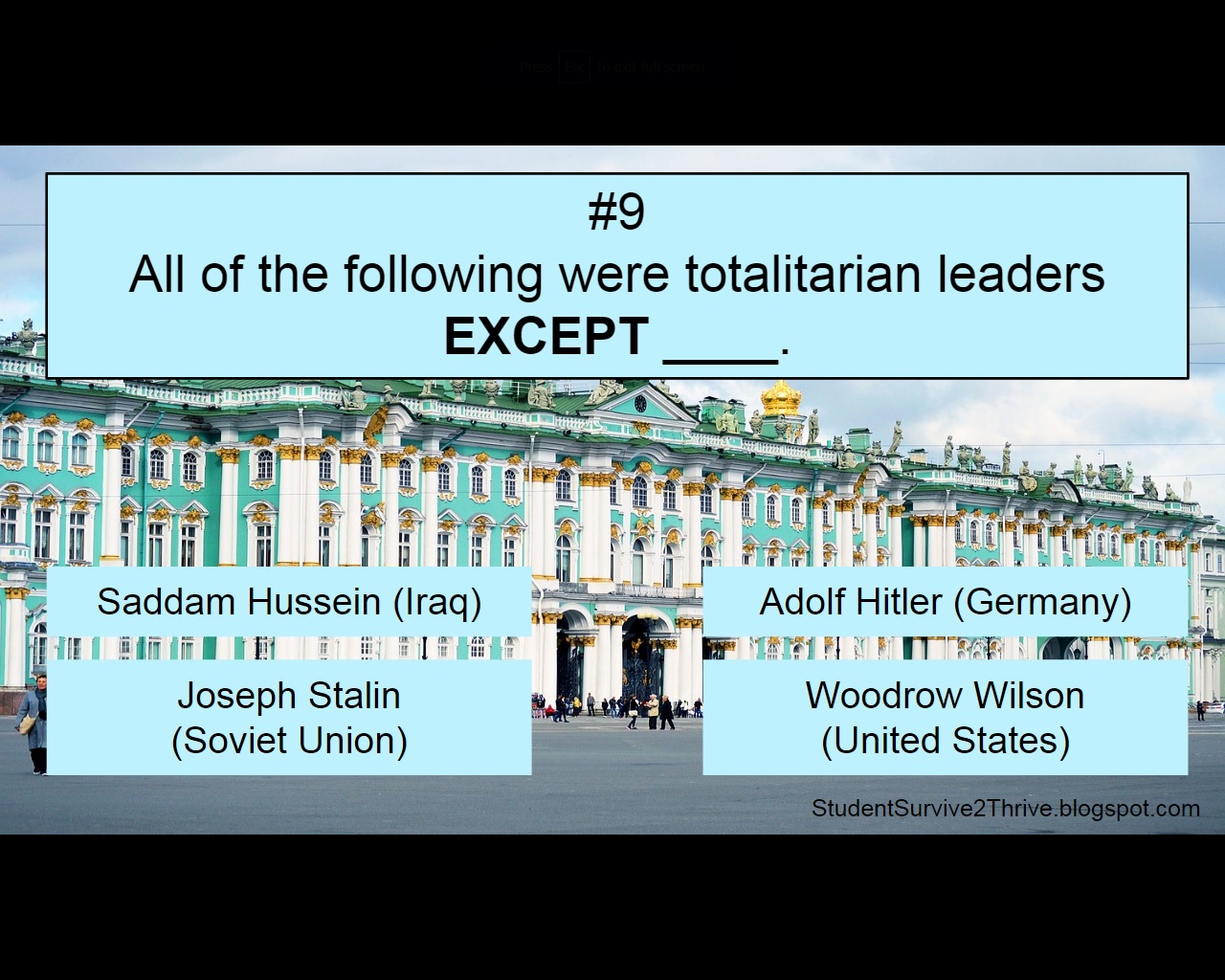
All of the following were totalitarian leaders EXCEPT ____. Answer choices include: Saddam Hussein (Iraq), Adolf Hitler (Germany), Joseph Stalin (Societ Union), Woodrow Wilson (United States)
All of the following were totalitarian leaders EXCEPT ____.
Answer choices include: Saddam Hussein (Iraq), Adolf Hitler (Germany),
Joseph Stalin (Societ Union), Woodrow Wilson (United States)

The correct answer is Woodrow Wilson (United States).

The Great Purge resulted in the death of ___ people in the USSR. Answer choices include: 8,000-13,000; 80,000-130,000; 800,000-1,300,000; 8-13 million
The Great Purge resulted in the death of ___ people in the USSR.
Answer choices include:
8,000-13,000; 80,000-130,000; 800,000-1,300,000; 8-13 million

The correct answer is 8-13 million.

What religious teaching was allowed & indoctrinated in the USSR during this time in history? Answer choices include: Atheism (belief in no God), Christianity, Buddhism, Islam

The correct answer is Atheism (belief in no God).

By 1950, ___ percent of Soviet doctors were women. Answer choices include: 5, 50, 75, 95
By 1950, ___ percent of Soviet doctors were women.
 Answer choices include: 5, 50, 75, 95

The correct answer is 75.

___ overthrew the Qing Dynasty & hoped to establish a modern government based on nationalism, democracy & economic security for China. Answer choices include: Mao Zedong, Sun Yixian, Jiang Jieshi, Joseph Stalin
___ overthrew the Qing Dynasty & hoped to establish
a modern government based on nationalism,
democracy & economic security for China.
Answer choices include:
Mao Zedong, Sun Yixian, Jiang Jieshi, Joseph Stalin

The correct answer is Sun Yixian.

In 1989, shortly after the anniversary of an event to remember the protest of the Versailles Treaty, the Chinese army killd/injured thousands of protesters in ___. Answer choices include: The Lincoln Memorial, Winter Palace, Tiananmen Square, New Delhi
In 1989, shortly after the anniversary of an event
to remember the protest of
the Versailles Treaty, the Chinese army killd/injured
thousands of protesters in ___.
Answer choices include:
The Lincoln Memorial, Winter Palace, Tiananmen Square, New Delhi

The correct answer is Tiananmen Square.

Chinese Communists traveled 6,000 miles on foot, crossing 18 mountain ranges & 24 rivers to flee from the Nationalist forces. This is called the ___. Answer choices include: Long March, Trail of Tears, Grueling Hike, Tea Party
Chinese Communists traveled 6,000 miles on foot,
crossing 18 mountain ranges
 & 24 rivers to flee from the Nationalist forces.
This is called the ___.
Answer choices include:
Long March, Trail of Tears, Grueling Hike, Tea Party

The correct answer is Long March.

Chinese Nationalists & Communists unexpectedly began to work together because ___ invaded China. Answer choices include: Russia, Turkey, Germany, Japan
Chinese Nationalists & Communists unexpectedly began to work
together because ___ invaded China.
Answer choices include: Russia, Turkey, Germany, Japan

The correct answer is Japan.

The ___ allowed Britain to jail Indian protestors without trial for up to two years. Answer choices include: 6th Amendment, Albert Bill, Rowlatt Acts, Colosseum Clause
The ___ allowed Britain to jail Indian protestors
without trial for up to two years.
Answer choices include:
6th Amendment, Albert Bill, Rowlatt Acts, Colosseum Clause

The correct answer is Rowlett Acts.

___ was an Indian leader who encouraged civil disobedience & nonviolence to achieve independence after the Amritsar Massacre. Answer choices include: Mohandas Gandhi, Muhammad Ali, Mustafa Kemai, Sir Daniel Hamilton
___ was an Indian leader who encouraged civil disobedience &
nonviolence to achieve independence after the Amritsar Massacre.
Answer choices include: Mohandas Gandhi, Muhammad Ali,
Mustafa Kemai, Sir Daniel Hamilton

The correct answer is Muhandas Gandhi.

An Indian boycott of British ___ and ___ created an economic burden on Britain. Answer choices include: wheat/rice, coal/oil, cloth/salt, opium/tobacco
An Indian boycott of British ___ and ___ created
an economic burden on Britain.
Answer choices include:
wheat/rice, coal/oil, cloth/salt, opium/tobacco

The correct answer is cloth/salt.

Mustafa Kemal successfully led nationalists to overthrow the last Ottoman sultan in ___. Answer choices include: Spain, Turkey, China, Saudi Arabia
Mustafa Kemal successfully led nationalists
to overthrow the last Ottoman sultan in ___.
Answer choices include:
Spain, Turkey, China, Saudi Arabia

The correct answer is Turkey.

Find more resources at StudentSurvive2Thrive.blogspot.com


Sunday, May 28, 2023

Week 15 World History: Societies and Empires of Africa 800-1500


Image of Ancient Egyptian Writing by photosforyou at https://pixabay.com/photos/egypt-writing-character-wall-gold-2226780/
Image of Ancient Egyptian Writing by photosforyou at
https://pixabay.com/photos/egypt-writing-character-wall-gold-2226780/

This world history resource focuses on the formation 
of Western Europe during 800-1500 and includes quiz
questions and answers and video links to related topics.

I utilized World History: Patterns of Interaction (Holt McDougal) for our world history textbook. It has multiple options for different learning styles and covers a wide array of information.

This quiz accompanies Chapter 15: pages 406-437.

Directions for the quiz:

  • Scroll down and click on the thumbnail to enlarge to full screen.
  • Click on the graphic to advance to the next screen.
  • Choose an answer for each question.
  • Compare your answers with those provided.

If you are interested in a group and/or interactive version of this quiz,
log in to Kahoot! and search for Week 15 World History by Katrena.

Below are free videos to accompany chapter 15: 

Thanks for visiting my Student Survive 2 Thrive blog.

Navigation is simple by using my site map,
topics on the right, or via my search bar.


Here are a few of my articles you may find helpful this week:


World History Week 15 Socieities & Empires of Africa  800-1500
World History Week 15 Socieities & Empires of Africa  800-1500

Created by Katrena. All rights reserved.

The ____ are a hunting-gathering society in the Ituri Forest of the Democratic Republic of Congo. Answer choices include: Almohads, Efe, Berbers, Soninke

The correct answer is Efe.

A ____ society, like the Igbo people of southern Nigeria, developed lineage-based systems of governing. Answer choices include: stateless, communist, republican, democratic

The correct answer is stateless.

A Muslim scholar from Morocco, _____ founded a brotherhood called the Almoravids that attempted to spread Islam throughout the area. Answer choices include: Abd al-Mumin, Kagemni, Abd Allah Ibn Yasin, Ibn Tumart

The correct answer is Abd Allah Ibn Yasin.

In the third century, Berber nomads began using ____ as they traveled across the Sahara. Answer choices include: oxen, horses, camels, donkeys

The correct answer is camels.

West Africa supplied about ___ of the world’s gold supply until about 1350. Answer choices include: 1/3, 2/3, 1/2, 3/4

The correct answer is 2/3.

Mali’s first great leader, ____, overthrew an unpopular leader, promoted agriculture, & re-established gold-salt trade. Answer choices include: Sundiata, Mansa Musa, Sumanguru, Ibn Battuta

The correct answer is Sundiata.

___ captured the trade cities of Timbuktu & Djenné in the mid 1400s. Answer choices include: Queen Amina, Aski Muhammad, al-Bakri, Sunni Ali

The correct answer is Sunni Ali.

For what was the West African state of Kano known? Answer choices include: dyed cloth, woven cloth, leather goods, all of these

The correct answer is all of these.

What did Zazzau primarily trade in the 1500s? Answer choices include: rice, gunpowder, enslaved persons, salt

The correct answer is enslaved persons.

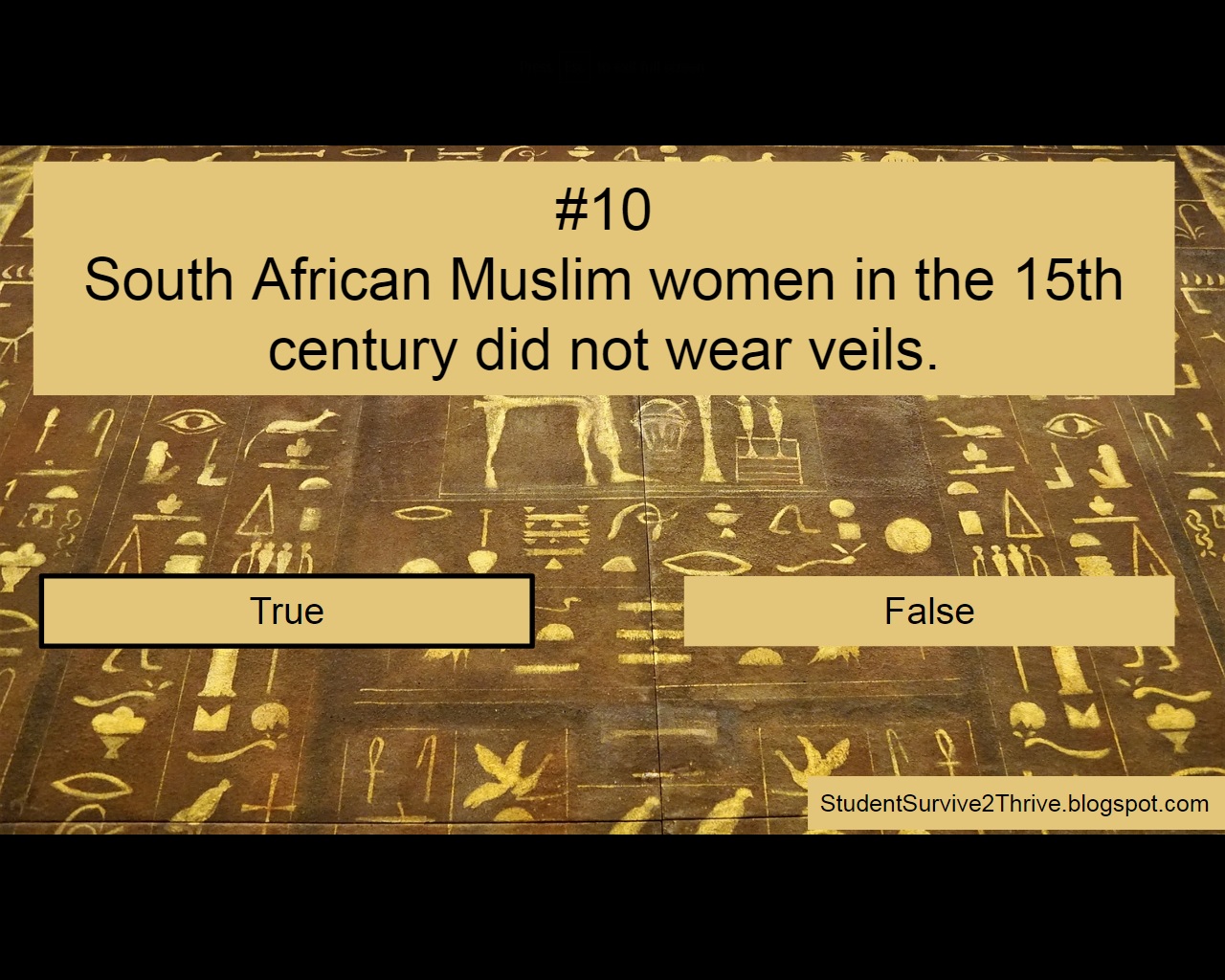
South African Muslim women in the 15th century did not wear veils. Answer choices include: true, false

The correct answer is true.

Benin became famous for its ______. Answer choices include: watercolor designs, sculptures, origami, tiles

The correct answer is sculptures.

The _____ language was created by blending Arabic & Bantu. Answer choices include: Sanskrit, Swahili, Greek, Latin

The correct answer is Swahili.

In the late 1200s, ____ was the most powerful and wealthiest coastal city-state. Answer choices include: Sofala, Mombasa, Kilwa, Malindi

The correct answer is Kilwa.

In the late 1400s, ____ took control of many city-states on the east African coast, including Sofala, Kilwa, and Mombasa. Answer choices include: Portugal, China, Poland, Germany

The correct answer is Portugal.

______ had a curved wall called the Great Enclosure containing about 900,000 stone blocks held together without mortar. Answer choices include: Aksum, Madagascar, Lalibela, Great Zimbabwe

The correct answer is Great Zimbabwe.

Find more resources at StudentSurvive2Thrive.blogspot.com